Last of the Gun Fighters
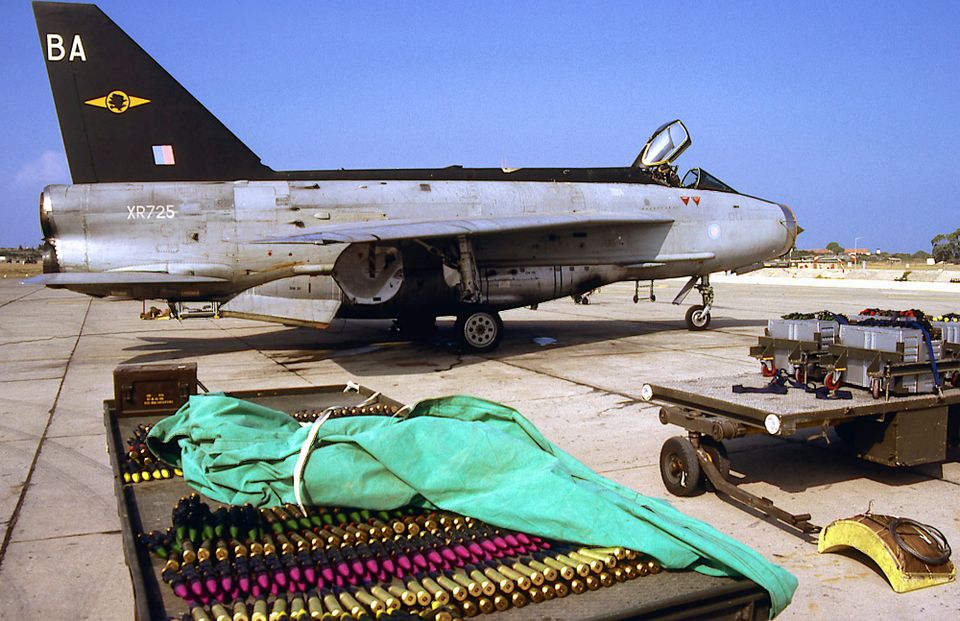
Last of the Gun Fighters...Well, almost...
In 1960, the RAF introduced the English Electric Lightning into service with 74(F) Squadron at RAF Coltishall in Norfolk. On paper, it was a formidable fighter, capable of Mach 2.0, armed with two infra-red Firestreak missiles and two shoulder-mounted 30mm ADEN cannons. What more could a man want? Indeed.
The next variant, the F Mk1A, had subtle improvements, and following on, the F Mk2 introduced even more tiny tweaks. What more could a man want? Then came the bombshell: the newest version, the F Mk3.
Finally, the RAF had a Ferrari of fighters: bigger engines, a revised and very state-of-the-art cockpit, a square-top fin, and the super-secret Red Top air-to-air missile, of which two could be carried. What more could a man want?
Well, all this high-tech gubbins - which is, in itself, a lovely word - came at a price: space.
The OR946 instrumentation and the Red Top missiles needed lots of things that went "ping", and something had to give. Surely not? But yes - the gun was removed. Heaven forbid.
It took a while for the penny to drop - sorry, Penny - but for the first time since 1918, the RAF no longer had its primary fighter armed with a gun.
Well, that's what all the magazines wrote, which wasn't strictly true, as the F Mk2 and 2A always carried a gun.
For a while, no one cared. It was the supersonic missile era and who needed guns anyway?
Well, actually, we did.
Pilots being chased by missile-armed fighters tend to run away bravely and perform some pretty slinky manoeuvres to avoid getting shot down.
The one weapon that was pretty much unjammable was the air-to-air cannon.
All you needed to do was get into your opponent's shorts - around 200 yards or closer - put your pipper (gunsight) on his back, squeeze the trigger, and he's toast.
Unlike a Spitfire or Hurricane, one 30mm HE shell pretty much anywhere on a Cold War jet would bring it down.
Now, the RAF had a dilemma. They had ordered around 150 of the Mk3 and Mk6 versions, and they lacked a cannon. The solution was not easy: how do you retrofit a gun into the later Lightnings?
The Mk3 Lightnings had no available space, so they had to make do with being emasculated.
The Mk6 version had the big 600-gallon ventral fuel tank, and perhaps there was a way to squeeze in a couple of guns around the fuel tank. Genius idea!
Having gone to enormous lengths to give the Lightning as much fuel as it could possibly carry in the ventral tank, BAC now had the unusual task of undoing all their good work and seeing if they could squeeze a pair of cannons and 120 rounds of high-explosive ammunition into it.

What could possibly go wrong?