
PART II - KNIFE FIGHT IN A PHONE BOX
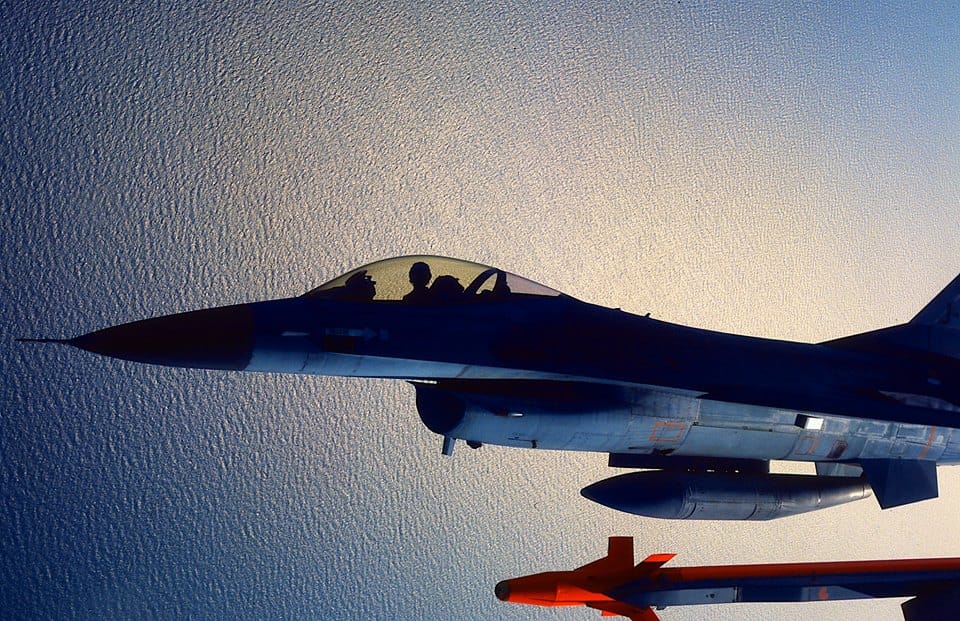
Fighting Falcon style
So let's think about fighting an F-16 or F-4 as for real in war we are not going to fight a Lightning, but a soviet fighter like a Mig 29 or Mig 23 similar to both the F-16 and F-4.
The F-4 had many guises The English version F-4K/M or American version F-4E or other export versions- like the German F-4F.
In Fighter aircraft they have built in weapons systems, so first let's look at the radar - UK Phantoms had the AWG 11-12 -Pulse Doppler radar which is way more powerful and capable than the Lightnings Ferranti AI23.
So we can store away the fact that the F-4 would see us first on his radar.
Perhaps a plus or perhaps a minus depending which side you dress but the Phantom is 2 crew - That means the guy in the front has a guy in the back to do all his little jobs - how cute. 🤗
It also means they have 2 pairs of eyes or 4 eyeballs - so in a big fight - multi bogey you can divide your attention on the good guys and bad guys - single seat, to coin a phrase you are on your Todd one pair of eyes, one set of hands but obviously a massive brain...
The Phantom is bristling with weapons radar guided missiles, heat seeking missiles, guns and infra red decoys, and perhaps chaff an anti radar device.
In our steam driven Lightning we have two pretty basic missiles 2 x 30mm cannons and zero self defence capability or do we...
Being cunning and sly old chaps we did have one little ace up our sleeves DIY Chaff - which if you are over 100 years old was known as “window” and is an anti radar device - Thin strips of aluminium that are ejected into the air and used to fool enemy radars.
These metal strips were placed in small brown paper bags and lightly sealed allowing them to break open once ejected and swamp enemy radars.
Most modern fighters have small dispensers or carry pods that Chaff can be dispensed from.
The Lightning had none of this high tech stuff so we had to be a bit sneaky.
The airbrakes on the Lightning are mounted at the rear of the fuselage and operated by a switch on the throttles by the pilot.
After engine start ground crew would signal for the airbrakes to be opened and then bravely clamber up the fuselage and stuff bundles of chaff into the airbrakes which we would then lock shut making sure we didn’t squish their grubby little fingers inside.
If we flew as a 4 ship formation we thus had 4 lots of chaff we could dispense to fool our enemy radars .
Of course a simple plan often led to simple mistakes.
On more than one occasion pilots would return to Binbrook not having used the Chaff in combat once in the overhead, select airbrakes out and cover the airfield in tin foil - very bad for the environment but even worse for the bases air traffic radar which we had now put out of action for ten minutes as little strips of tin foil floated slowly down to earth.
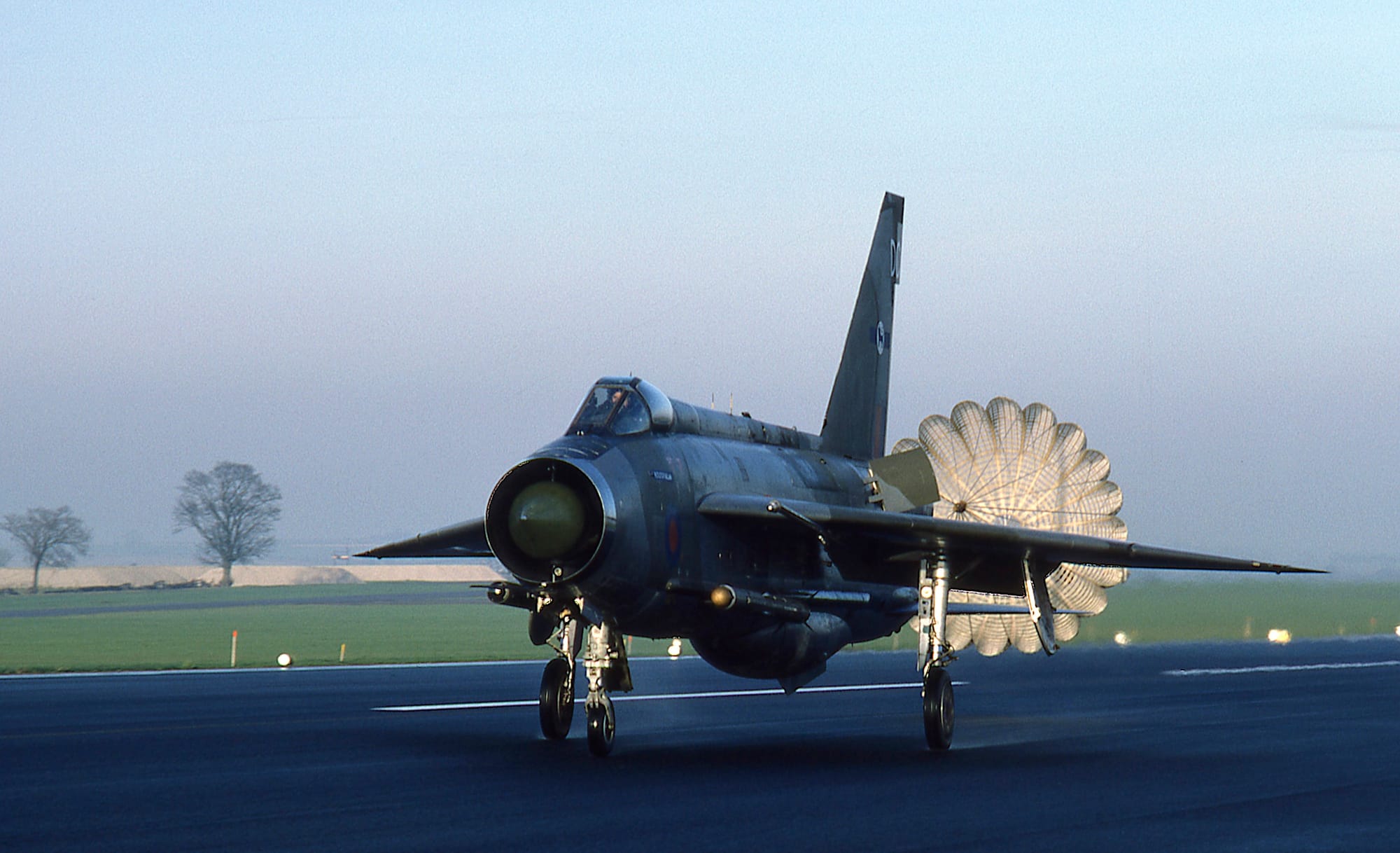
Back to knowing your enemy...
The F-4K/M Phantom was operated by the RAF so we knew all we needed to know - basically, at range they’d probably kill us with their radar missiles but close in we had the upper hand.
Our turn performance was much better but we didn't have as much fuel so we needed to be sure that we could exit the fight with the upper hand - running away short of gas is not a great place to be tactically.
The advantage of doing air combat against a target you are unfamiliar with is the surprise factor - rabbit in the head lights syndrome.
Lets look at how the USAF developed air combat tactics with lessons learned from the Vietnam war.
In training you pretty much know that on a 45 minute sortie you might get three individual set ups so you have a few game plans stashed away in your G suit pocket.
In war that first pass its crucial you know what your actions are and so the Red Eagles were born.
At a secret location in the Nevada desert the USAF formed a top secret Squadron flown by American pilots but flying Russian Migs - The story is well known and there are a few excellent books on the subject. (plug for Steve Davies Red Eagles and Rob Zettle’s Mig Squadron)
But the primary aim of the programme known as “ Constant Peg” was to give rookie pilots the experience of meeting a Mig in the sky in a peacetime environment over home territory - No more rabbits in headlights.
In the RAF we didn’t have the luxury of fighting Migs (until the East German Air Force obliged in the late 1980’s) But what we did have was the 525th Aggressor Squadron based at RAF Alconbury a USAFE (Europe base)
These guys flew the diminutive F-5 Freedom fighters and they replicated Soviet fighters - These pilots were good - very good, Top Gun pilots on steroids.
Once in a while we would either deploy to RAF Alconbury or they would come to us - Have Migs, will travel.
Rewind a few decades and 1988 was still Cold War city - we had one enemy and one enemy only the Russians or the Warsaw Pact. We didn’t consider the middle East or China as a threat it was the Bear with the big red star.
RAF squadrons had huge heavy metal safes that contained thick red books on Soviet warplanes, missiles and tactics, all marked NATO SECRET.
What none of us knew at the time was the Americans were flying a whole squadron of Migs in secret - they guarded their secret better than the contents of a Nuns bedside drawer.

On my first detachment to Alconbury I sat in a briefing that was more secret than where my wife keeps her diary - Doors with “BRIEFING IN PROGRESS TOP SECRET" were illuminated with neon signs.
I sat perplexed as our American aggressor pilots told us about the Mig 21 - 23 and what they could do. They knew everything, turn rates, fuel burns, weapons envelopes christ even how many landings they got from one set of tyres.
My inquisitive brain worked overtime as i tried to work out how they knew so much.
But this Aggressor pilot knew so much more about Migs… I was intrigued.
I didn't push my boyish inquisitiveness but I knew there was a lot more than they were not telling us - Did they have an exchange programme with the Russians ?
My mind raced..
Years later I was in a bar in Vegas...amazingly, fully clothed and I was chatting with this super cool guy - In fact it was the officers club at Nellis. The F-117 Night Hawk programme had just been made public and I knew from his arm patches he was a Bandit pilot - the nickname for the F117 guys.
He’d had a couple of strong Shandies and possibly a cider so I chanced my arm and asked him all I dared. He spilled a few beans which I’ll save for another day but my big question was how did you keep the F117 / Mig programme secret and he told me a story...
It was clear the yanks had been operating a secret Mig Squadron for some years and that's how they knew the most intimate details of how Russian fighters flew.
Back to our mission and today we fight the F-16 Falcon and we were definitely out classed before we even strapped in...
In 1987 the F-16 was state of the Art high tech military muscle - that's a quote straight from a high end London ad agency.
What made the F-16 special...? Lots!
It was the result of the aftermath of the Vietnam war when the Americans realised as good as the F-4 Phantom was, it was not a dogfighter, they needed an agile small aircraft that could fight and turn and beat the Russians in an ever changing game of three dimensional chess.
As a young school boy I was obsessed with combat jets - and would do anything to watch jets rip up the sky. In an era pre internet I somehow found out that the latest combat aircraft from General Dynamics the F-16 was going to give a demonstration to senior USAF Generals at RAF Bentwaters, just a few miles from my school in Woodbridge...
Armed with my trusty Russian camera long lens some cucumber sandwiches and lashings of home made ginger beer I set off on my bike to catch a glimpse.

Hiding in bushes near the perimeter fence I settled down for a long wait.
Having eaten my packed lunch faster than Peter Mandelson could unwrap his lunch box I heard the distinctive sound of jet noise.
Peering through the view finder I watched a moment in history as the red white and blue prototype F-16 took up its place on the runway - alongside it a rather drab looking F-4E Phantom in its Vietnam era paint scheme.
At this stage in my life, all I knew about curves was probably Ms Martinique our French teacher who kept us captivated with her vocabulary and rather pleasing upper deck.
What I was about to witness was an early lesson in SEP curves something that in under a decade would rule my life. SEP is fighter pilot speak for specific excess power these diagrams in the shape of curves were a lot less interesting than Ms Martinique, but vital for a fighter pilots understanding of how the enemy's aircraft performed.
Despite replacing the Lightning with the Tornado F3 the RAF never really had an agile fighter (apart from the Hawk) until the Eurofighter Typhoon arrived late in the 1990s.
Having witnessed the awesomeness of the F-16 as a school boy I was lucky enough to get a back seat ride in one with the Dutch Air Force at Leeuwarden.
I was 20 years old and only shaving once a month and now sat in the back of a brand new F-16 Falcon. Probably 6 years since eating my cucumber sandwiches witnessing the first F-16 in UK skies.
An aircraft that was about to give me an experience of a life time and at that time, pulling 9G was the thing to do - like the Ten Ton club, you even got a badge and bust blood vessels!
For those unfamiliar pulling 9G means your body which might normally weigh 12 stone is multiplied by X9 so you now weigh 108 stones! - Now this might even be too much even for a big jab of Ozempic, and the hard part is your head which might weigh 2 Kgs now weighs 18 Kgs and you need to support that with the same neck...
My mission back seat F-16 was a 1 vs 1 Combat sortie against a German Air Force Phantom.
At the merge (where we go beak to beak) My little Dutch friend pulled as hard as he could into Herman ze German and I was not prepared - As we hit 9G my 1G neck decided this was too much and my head rolled forward, which, in most circumstances would not be the worst thing...Only my head rolled forward with an oxygen mask and tube attached, crushing it in half.
I breathed in...or tried to and soon realised that I couldn't, I was suffocating!
As the G piled on I couldn't breathe and I couldn't speak to tell him to back off. It probably only lasted 30 seconds but half a minute is a long time being strangled!
As he took his shot and relaxed my Oxygen came back and I breathed deeply.
I’d just experienced modern air combat - the world of 9G and from that instant I knew the F-16 was the ultimate turning machine.
Our Mission 2 vs 2 Dissimilar Air Combat Lightning Vs F-16s. The Brits vs the Cloggies, a polite name for our Dutch friends.
Like a big boxing match, in the Left hand corner we have the English Electric Lightning twin engined with twin missiles and two Aden Canons. To get you in the fight, a Ferranti AI23 monopulse radar, that whilst good in its day, was well past its sell by date.
And in the right hand corner the F-16A fighting Falcon of the RNLAF ( Royal Netherlands Air Force) Fitted with an early basic radar it was fly by wire (side stick control) single engine armed with a gun and two heat seeking air to air missiles. Whilst the airframe was gucci the weapons were still in their infancy.
The Americans are nice people but when they hand out a jar of sweets they keep all the nice ones for themselves.
The Dutch had the F-16 but they were sold a pretty basic missile the Sidewinder 9J which was not much better than our ancient Firewood or Firesteak.
The Aim 9J was pretty reliable but you still had to get behind your opponent within 30-40 cone of his backside, and that gentleman is the hard part as we all know.
The year is 1988 and the Americans had already developed what was a game changer in terms of air to air missiles the Aim 9L sidewinder the first all aspect fire and forget heat seeking missile.
This was literally mind blowing, pilots had to re write the combat book now you could get shot in the face which really wasn’t very British.
It meant that you couldn’t enter a fight head on burners blazing as it loved a hot spot and your tail pipe was as hot as Jeffrey Epstein's e mail account.
Now at the merge you had to assume your enemy had an Aim 9L or Soviet equivalent and this meant cooling your jet pipes.
So as we came face to face instead of being at full power we would be at idle as well as throwing out infra red decoys to fool the 9Ls seeker head - in many ways the missile was brilliant but it also spoiled a lot of our old school fun.
But the 9L ( LIMA ) was not fitted as yet so we could relax a little. As we are fighting our F-16s with rear aspect missiles we don’t have to worry about being shot in the face so we can just turn and burn.
Our set up is done by GCI - the ground radar guys so we start 20 miles apart and then try to find the bad guys on our radar and as quick as we can strut our stuff and try and get in unseen.
In the time it takes you to read this we will have gone from 20 to 10 miles, dropped our chaff to decoy the enemy, probably changed our height by 10,000 feet and kept in visual contact with each other.
As we come to visual range we fold our radar boot away and look out.
The F-16 is tiny, smaller than a Scotsman’s wallet and we are lucky to see them head on at 5 miles.
We know there are two - a bit unrealistic as in war time we probably won’t know how many there are so as soon as we see one we need to look for the other.
Now comes the art of being a cunning linguist.
Once things kick off, flying the aircraft is the priority. Comms matter just as much though, and we use a set of code words to keep everyone on the ball...
key words;
Visual - I see my wingman / buddy
tally - I see the enemy
Tally 2 - I see both
Blind - I don’t see them
lost visual - I don’t see my wing man
Simples! Now add the free and engaged part...
Lead is engaging right hand turn going high - that tells my wing man I’m engaging in a right hand turn going high so he doesn’t try to engage the same target and we in slang clap hands!
So we are either free or engaged visual and tally but we must make sure we don’t lose comms and we must be 100% honest that we call out if we lose contact straight away to avoid mid air collisions.
As we are fighting 2 vs 2 we could end up fighting 2 vs 1 or 1 vs 1 as people take simulated kills.
Once a kill is called that aircraft exits the fight and waits for the next set up simulating dead... yes I know it's getting complicated.
So what’s a knife fight in a phone box?
Have we really finally got here?

Really the phrase only came into being with the introduction of the F-16- close combat. Previously fighters would often be 1 - 2 miles apart and combat manoeuvring was pretty ponderous if that's possible in the high octane high adrenaline world of air combat.
The advent of the F-16 and its turn, meant you never got far apart as the Falcon out turned anything at that stage.
This changed the dynamics as you tended to fight harder and this meant you lost energy and speed quickly and very often you would end up at base height - remember, normally a hard deck in peacetime of 10,000 feet.
Or you could end up scissoring - (sadly I only learnt yesterday that it's not only a combat term - what have I been missing out on!)
And this is where the knife fight in a phone box gets interesting.
Whilst the F-16 might be able to pull 9G, once its down to say 150 kts, the computer takes over and says you need to back off now or you’ll lose control so it won’t let it get below a certain speed.
In a Lightning however you can happily fly down to 150 kts in full reheat and still manoeuvre - as mentioned now you are down to the skill side where the pilot can roll and turn his aircraft whilst feeling the buffet and the stick forces to wring every once of performance from his aircraft - so in a skilful pair of hands a Lightning could have the upper hand in a knife fight.
One other issue though is this knife fight will normally be near base height at slow speed both aircraft on the edge.
So the moral of the story is, although the Lightning might be better at slow speed scissoring, you really don’t want to get yourself into that area by choice!