
P1B July Newsletter
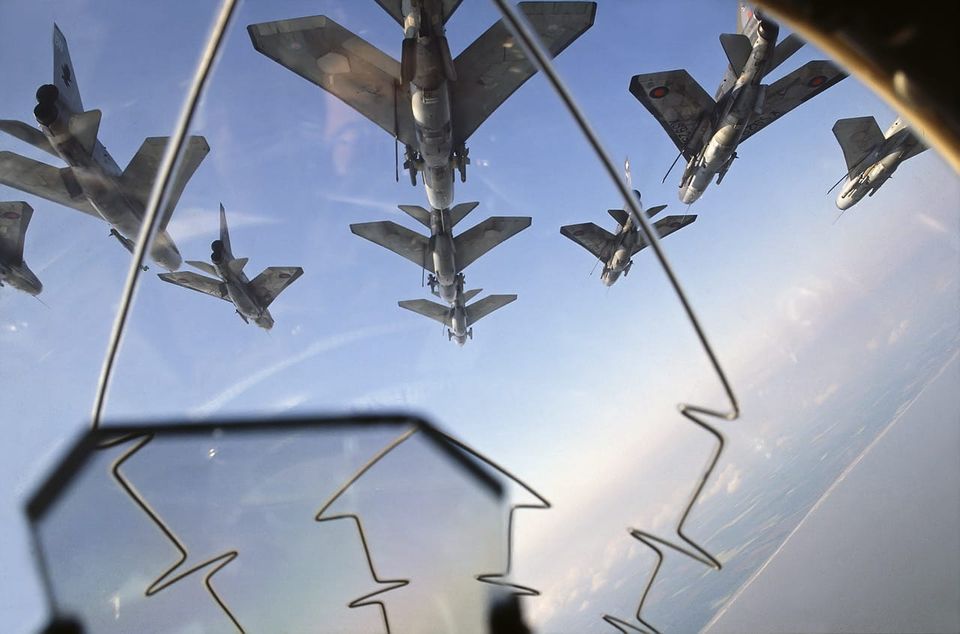
Formation is Fun
Forward, Up and In... No, you are not at a teenage party upstairs when the parents are away. It's how they taught formation flying in the RAF.
I thought it might be rather jolly to talk about formation flying in the Lightning, but to give you some background, if you're not a pilot, it's probably time to explain how you actually fly formation and why we do it.
Why do we fly in formation? Good question.
Well, for people on the ground it looks pretty, and for those in the air it's a skill set that takes a bit of... well... skill. It's actually rather good fun.
Of course, there are more practical reasons too. As a fighter pilot, one of your main tasks is to watch your leader's or wingman's rear end. Clearly, in the days when all fighter pilots were men it wasn't that much fun... nowadays it's a little easier on the eye!
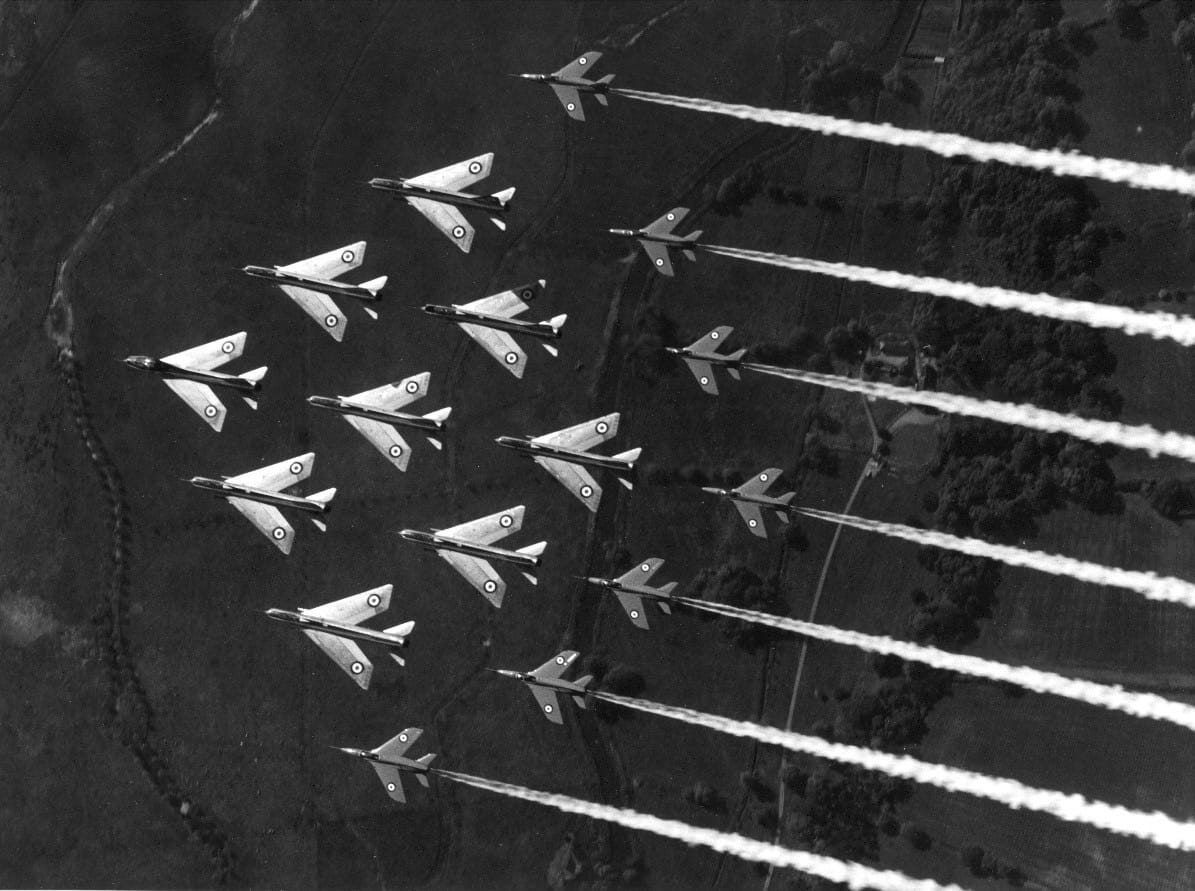
So what's the tactical advantage?
Firstly, getting airborne as a pair in formation. (I've actually had a threesome... in a Lightning, which was rather novel and puts you right on the edge of the runway.)
The advantage is that you can both take off at the same time, which cuts down runway occupancy - I love that phrase - and R/T. I'll talk a bit more about formation take-offs once I've described how we are taught formation flying.
Wandering off the subject for a moment, the South Africans call it "Form" for slang, and the French Air Force called it "PS", which stands for Patrouille Serrée, translating to "tight formation".
Still with me? Good.
So where and when do baby pilots learn to fly close?
In my era it was in the mighty Clockwork Mouse, the Jet Provost. The only aircraft I have flown that's more pointed at the back than it is at the front. It's where you have your first experience of flying close.
Now, the Jet Provost is an ideal training aircraft but - and it's a huge but - it's utterly gutless. The Viper engine produces huge amounts of noise, very little thrust and burns a colossal amount of fuel.
So the first thing you need is a briefing.
So, back to the whiteboard.
The instructor starts with the basics. Flying straight and level, the leader picks a heading and tells you his speed. Let's say 090 degrees and 180 knots.
You now know his heading, speed and, if you are visual, his height.
If you start half a mile behind him and have 60 knots of closure (240 knots), how long will it take to hit him?

Hurry up.
Well, you are covering one mile a minute, so 30 seconds to impact.
File that away for later, because it's important.
So you know your overtake, and that allows you to judge your closure rate.
The next thing is back to the first line...
FORWARD - UP - and - IN
No foreplay here. It's a matter of getting in quickly and not prolonging the procedure.
The biggie - and that's a word I've made up - is to ALWAYS have an escape lane. You need to be separated from your leader laterally and vertically, and only when you are in control do you close up.
So you know his speed and add a fistful of power. The mighty JP trundles forward and now you need to understand the term "ballooning".
I'm trying to think of something witty that's not too rude, as it might be a game you play on your honeymoon night, but it's actually the most crucial part of formation flying.
As you see an aircraft in the distance, all you see is a speck. As you get closer the size increases, and then you reach the ballooning effect.
It gets bloody massive.
The trick is to recognise when this happens and not have too much overtake or speed, otherwise you'll just go whizzing past.
So how do you control your overtake?