
Tanking… Lightning Style
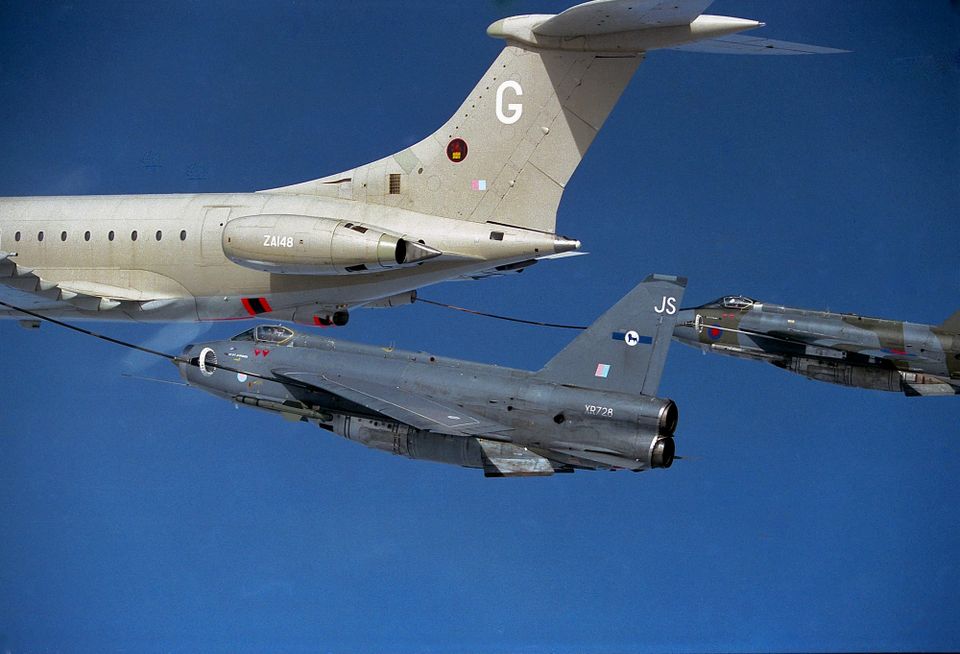
There’s a reason why Lightning pilots are tougher than woodpeckers’ lips...
This month’s little extra is a pilot’s perspective of how to refuel a Lightning in mid air at 350 MPH. I didn’t want to lower the tone straight away but it was often described as taking a running f**k at a rolling donut! No point trying to gloss it over, it was initially at least a very tricky skill set, but a bit like marriage, after a while it’s going through the motions.
Let’s start with the basics.
The Lightning was built and designed as a “fire and forget” fighter. That’s to say it was supposed to sit at the end of a runway, light the blue touch paper, accelerate like a weasel that’s caught its back wheels in a mouse trap and climb to 40,000 feet in a few minutes. Rushing along at 600kts or Mach 1.6 it would be guided to its target, the pilot would carry out the intercept, fire off one or two missiles and be home in time for tea and medals.
That was the plan but it left no margin for error.
Fuel was always the Lightning’s Achilles heel. The early Lightnings carried 630 gallons of fuel which was then augmented by a jettisonable slipper tank giving an extra 250 gallons. If you ever wondered where all the fuel in a Lightning was then today is your lucky day, impress your friends at the pub quiz night.
First off there is no fuel in the fuselage because by design the intake and engines didn’t allow it. This meant the designers only had one place to squeeze every last drop, the wings. But there was a problem, the wings also had the main undercarriage and flaps.
So they literally filled every crevice with fuel, including leading edge fuel tanks and wet flaps.
Now this was clearly a great idea in 1954 but the concept was only really meant for an aircraft with a service life of a few years. Many other fighters have fuel stored in rubber bags but the Lightning had fuel tanks built into the structure. It was rubber free.
Of course keeping the tanks sealed was a major issue and after a while of pulling high G they leaked, and leaked badly. There was a temporary fix and that came in the shape of a nasty product called PRC. This was a two part epoxy resin that was flexible and sealed tanks but was also subject to cracking and leaks.
Quickly the design team realised that wet wings were not the answer, they needed more gas! But how?

First idea, the slipper tank. That was a great idea but with every plus there is a minus. The plus was more fuel, the minus was that it was fitted onto the lower fuselage under the number 1 engine, and what do jet fighter engines do? They get hot, very hot, so there was an issue with fires.
Irrespective, the idea was sound and the P1B was duly fitted with the slipper tank.
In an aircraft that was renowned for spontaneously combusting, luckily the idea was abandoned.
But it was clear early on that this was not enough and so a solution had to be found to increase fuel capacity even further. The way the Lightning was designed allowed no room for growth. It was a very clever design but didn’t really allow any future proofing.
Other fighters, and I always come back to the F-4 Phantom, had a pretty much clean under wing area that you could hang five hard points on as well as four recessed missiles. The Lightning had no such luxury as the undercarriage took up 50% of the wing and the under fuselage was where the engines were, so that was too difficult to strap external stores on.
For export Lightnings they had two under wing hard points for SNEB rockets or 500lb bombs so you could have put some small fuel tanks on pylons, but a more radical idea was needed and eventually they decided to put the tanks above the wings. Very British to go on top, and of course keep your socks on..